

In the previous series on "Thinking in AI" that I started here, I discussed the usefulness of understanding, framing, and breaking down complex problems into well-defined data types and tasks.
One of the data types that I covered was graphs or networks (which I will refer to generally as networks in this series).
Compared to structured data types like tables, or unstructured data types like text, networks are fascinating because they can be both or either. They can be structured in that their connections can be explicitly defined, yet they can represent highly unstructured and complex relational patterns not easily captured in rigid tables.
Hence, they are not exactly structured like tables because their structure - nodes connected to each other by edges - can be highly irregular. But neither are they unstructured. In fact, relational structures in network data are probably the richest source of information.
Networks were quite a popular topic in AI research prior to the focus shifting to Generative AI in 2022. The use of techniques such as Graph Neural Networks (GNNs) or even graph transformers to learn and perform tasks on network data was one of the trending topics in research then.
In the previous series, I mentioned pivoting from research on Generative Adversarial Networks (GANs), and this field of research relating to GNNs and graph transformers was what I shifted to (see my dissertation and my Google Scholar profile for a sense of my research). For a few years, I was essentially in the state shown in the image below.
While the enthusiasm surrounding GNNs and graph transformers has moderated since 2022, I can sense - in works such as GraphRAG, where we use graphs for retrieval for large language models (LLMs); and KumoRFM, an attempt at building a foundational model for relational data - a renewed enthusiasm for using Generative AI with network or graph data. Advantages of doing so include better performance, better explainability, or even new capabilities beyond what current LLMs can achieve.
Hence, in this series, I will follow the general flow in "Thinking in AI" to explain how to think about problems that have an inherent relational structure. Similarly, we will look at key techniques or models for network data, the inherent characteristics of network data, and tasks that are related to networks.
Just as "Thinking in AI" sought to provide an intuitive understanding of AI, this series will explore the fundamentals of networks and their role in AI, as well as Generative AI so that one can get an intuitive understanding of this domain.
Again, I have to stress that most of the concepts we'll discuss are not new, particularly to researchers in network science or graph theory, but I hope that articulating them through the "Thinking in X" lens will be useful for those less familiar, or for those looking to apply these ideas in new contexts.
Thinking in Networks - Key Aspects
Personal or social media networks are probably what comes to mind usually when networks are discussed. But, like I mentioned earlier, there was a period during my PHD when I saw almost everything as a network. For a good reason, I think.
Think about the data type underlying the user interface you see on the screen of your mobile. Do we just focus on the visual image? Not really, since the underlying design of the user interface involving connections (edges) between different elements (nodes) plays a fundamental role in the user friendliness of the mobile application.
Think about the data type underlying the recent turmoil in the financial markets that started due to Trump’s tariffs few months ago. Do we just focus on the tabular or time series data of financial stock or bond prices? Not really, since the underlying relationships (edges) between different entities (nodes) play a fundamental role in understanding and explaining market price movements.
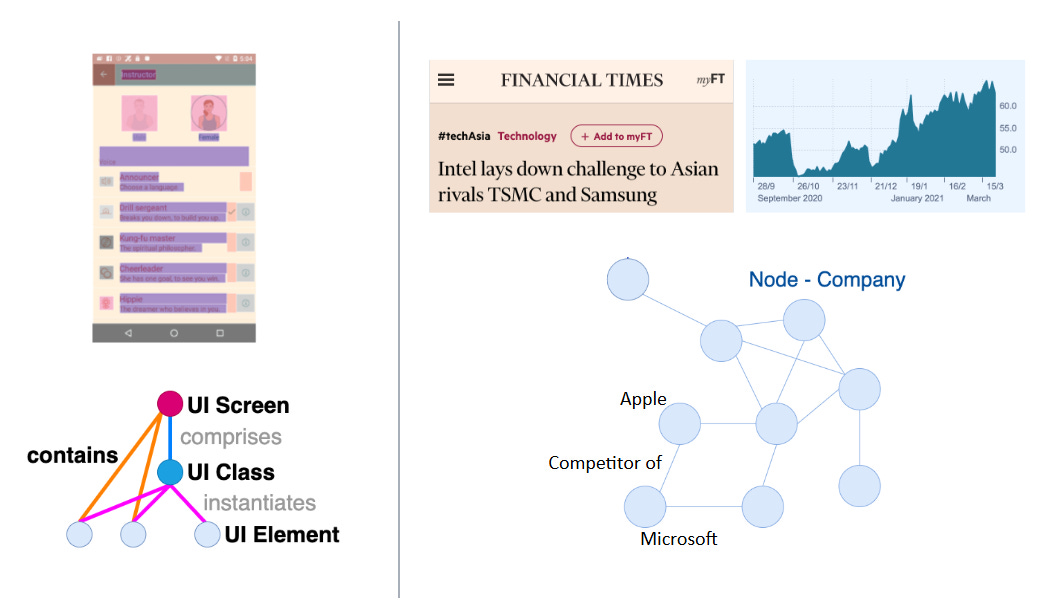
For these and other examples, one might try to just focus on either the visual images of the individual screen elements or their underlying code, or isolated financial time series or news reports. But this would be like trying to understand the pulse of a city by only tabulating its buildings or staring at photos of cityscapes, ignoring the vibrant and dynamic web of thoroughfares and human interactions that bring the city to life.
"Thinking in Networks" encourages us to map out these systems:
What are the key entities (nodes)? e.g., people, UI elements, companies.
What are the relationships between them (edges)? e.g., communicates with, linked to, supplies to.
What are the important characteristics of these entities and relationships (attributes)? e.g., friend or foe relationships, UI element functions, strength of a supply link.
Once we frame a problem as a network, we can often ask different, often more insightful, questions to solve different tasks.
For a mobile app, instead of just listing user interface elements, we can analyze how they are hierarchically and spatially connected, which directly impacts user experience, as explored in my research on networks in user interfaces (as seen in my research here, here, here, and here).
In finance, rather than looking at companies in isolation, my work on networks in finance (as seen in my research here, here, here, and here) shows how modeling inter-company relationships (be they explicit, implicit, dynamic, or knowledge-based) can significantly improve forecasting and risk management.
Even predicting a company's sustainability ratings becomes more interesting when we consider its network of corporate relationships (as seen in my research here and here).
Unfortunately, it’s non-trivial to use and analyze network data.
Even in this age of Generative AI, network data presents unique, and sometimes significant, challenges due to its non-Euclidean nature, heterogeneity, potential dynamism, and multimodality of attributes. These are what we will take a closer look at in this series.
The Interplay of Network Data and Tasks
Similar to Thinking in AI, a core tenet of this series will be that the network data you have shapes the tasks you can realistically perform, and these, in turn, guide your choice of analytical tools or AI models. We will explore:
Different Network Structures: From simple, homogeneous networks to complex heterogeneous, dynamic, and multimodal networks.
Network-Specific Tasks: Identifying influential nodes, predicting future links, detecting communities, classifying entire networks, or generating new graph structures.
Again, understanding this interplay moves us beyond a one-size-fits-all approach. It allows us to be more precise in defining our problem and in selecting the right methods to solve it.
Another advantage is that it gives us new ideas in applying established network concepts to new areas like Generative AI. For example, one of the key ideas in GraphRAG is that one can use community detection to generate more coherent sets of information that can be retrieved to use as context in LLMs.
What This Series Will Cover
By learning how to "Think in Networks," we gain another set of mental models to more effectively analyze interconnected systems and leverage the relational information in our analysis, or even when using AI or Generative AI to solve problems involving network data.
This upcoming series of short notes will explore:
Deconstructing Networks. We'll start with the fundamental building blocks: nodes, edges, and various types of attributes (multimodal, positional, edge-specific), and then delve into the unique characteristics of network data and why these matter.
Thinking in Network Tasks. This note will focus on framing problems through the lens of core network tasks (node-level, edge-level, and graph-level).
Network Analysis Meets AI. We'll bridge traditional network analysis with modern AI approaches
Thinking in Generative AI for Networks. We will explore how Generative AI and the domain of networks are intersecting.