

A friend, while congratulating me this week, asked why I changed my mind about doing a startup.
My reply was that it’s not really a typical startup where I needed to find an investor for. So not really a contradiction from what I told him earlier in the year.
But his message sparked some thoughts about how the envelope of what is possible has changed for me.
Aside from that, a fairly packed week. The final installment of training for my old workplace that tested an AI testing platform I have been building for weeks. The startup that a collaborator and I put something out into the world this week. Met a senior leader at a global bank who sparked some ideas on training for risk and compliance folks. And a few more gigs from meetings and DMs.
How I work, how I think, what I want to do has changed over the past few months. And I think a lot has to do with how the envelope of what I can and will do has expanded.
It’s brought me back to a few paragraphs I remember from a few decades ago, from Colin Goh and Woo Yen Yen’s essay called “Paved with Good Intentions”, the one that later inspired the film Singapore Dreaming. In it, they set two lives side by side.
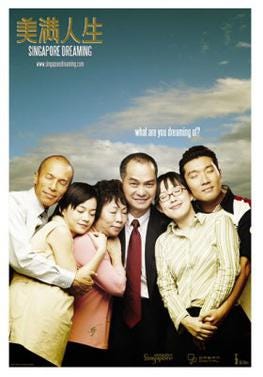
The first one.
“You wake up everyday and work from Monday to Friday, and often, Saturday too. If you finish work early, you and your partner go to your parents’ place for dinner and see your child for a few hours. If you work late, you buy a packet of char kway teow from the hawker centre but eat it at home because it’s too warm to eat there. You’re not crazy about the job but you know that if you keep at it, you can afford a car in 3 years’ time, and in 5 years’ time, buy a condo close to the primary school you want to send your kid to. Your conversations with people are either for the purpose of networking, work, or for familial obligations you cannot avoid. On weekends, you play golf with your friends at your country club or watch a movie with your partner. Once a year, you go on a ten day vacation to New York, London, or Paris, and when your children are big enough, Disneyland.”
That first life was, more or less, the one I had. Steady, and mapped out well in advance. There is a second life in that essay, set right beside it, and I will come back to it. First, my friend’s question.
What he meant
I knew what he meant. I had told him, at some point before I left or not long after, that I was not going to do a startup. Not because I lacked the ideas or the energy, but because I had a specific mental model of what a startup entailed. Fundraising. Managing people. Hustling. Exit as the end.
It made no sense. Raising money so I could work for a new set of bosses - investors. Being accountable to people I hired and managed. All of it felt like just going back to a full time job, in a different guise. And I think startup founders have a really hard job, juggling multiple roles and significant uncertainty.
In a way, conventional startup founders, until they make their first bucket of gold, are living a worse version of the life Colin and Yen Yen talked about.
I had seen enough of that world through my brother Gerald Ang to know it was not what I wanted.
Then why did I change my mind? And in a way, I am running two whole startups now. My own - Quaintitative - which does risk training and advisory, that has already been live and going well for the last 9 months. And this new one - TalentQuill with Stephen Tracy - which is just getting started.
I think something has changed. The envelope of possibilities has shifted, because of independence, my own mindset, and AI.
Independence and freedom of action
When I was at MAS, the envelope of what was possible was decided for me, largely. I’m a bit of a rebel, but even then, it’s probably one of the most structured environments around. I had to toe the line. For side projects, I would read my code of conduct carefully before doing them. Even to speak, we needed to seek approval, and prepare talking points for clearance in advance. Not that I used these talking points when actually speaking, but the process itself was a constant reminder of the boundaries. I’m fairly sure that what I speak about, and write about now would have gotten me a call back then.
Now that I am independent, I have to remind myself that these no longer constrain me.
Independence has expanded the envelope. Not just in the obvious sense of being able to choose my own work. In a subtler sense, I started to discover, by actually challenging myself, where the real limits were. This year alone I have done plenty that my old self would have sent up for approval, or quietly avoided. I write and speak in public, bluntly, about AI and where it fails, the sort of thing that I would not have even considered before. I set my own prices, and turned down work that did not fit. I put products out under my own name. I work with people I respect without needing anyone to sign off on it. I take on jobs in new areas outside of my comfort zone to diversify. None of those were walls. They were assumptions I had carried out of a previous life.
The things I had ruled out while inside the institution all became possible. Building products. Taking commercial risk. Setting my own price points. Saying no to things that did not fit. And necessary.
And then there is mindset
The harder limit was the one in my own head. I spent eighteen years in a place where you asked before you acted. You read the code of conduct before a side project. You cleared your talking points before you spoke. That instinct does not switch off the day you leave. For months I kept drawing the old envelope out of habit, waiting for a permission that was no longer coming from anyone but me.
What shifted was realising I am now the only one that needs to decide. I can start a thing, price it, ship it, or say no to it, without checking with anyone. If it fails so be it, I also answer only to myself. That sounds obvious written down. But not in my mind. It took a while to stop treating my own caution as a rule somebody else had set.
It’s an interesting feeling. Which brings me back to that essay, and the second life they set beside the first.
“Alternatively, you wake up and you have no idea what is going to happen today, tomorrow, 6 months or a year later. Ironically, because of this uncertainty, all possibilities exist for you. You can be the Prime Minister of Singapore, you can make a movie, you can cook a meal you have never cooked before, eat at a place you have never eaten before, you can color your hair red, you can skip instead of walk, you can volunteer at the school you have always wanted to volunteer at, you can write a book, or you can have a baby even though you don’t have a maid. You have conversations with people who set your heart palpitating and your mind on fire. Your weekday is not so different from your weekend because everyday you are thinking, creating, and more important, imagining.”
This is kind of what it feels like to live in the expanded envelope. The uncertainty is daunting, but it’s also liberating. But you do need a mindset shift to appreciate this expanded envelope.
And the final piece.
What AI made possible
One person doing what I am doing now would not have been plausible a few years ago. A bit insane even.
The volume of content, the breadth of delivery, the products being built in parallel with ongoing teaching and advisory work. None of that scales this way without AI as a genuine multiplier. Not AI as a chatbot you occasionally ask questions. AI embedded in how my work actually gets done. I have a working repository of my projects that has grown to more than a hundred folders, perhaps thirty of them live at any one time. And I run 10-15 sessions with agents, from Claude Code to Codex to Hermes, on an ongoing basis to keep everything moving.
What shifted was not that I became more capable at any one thing. It was that the cost and barrier of doing many things dropped enough that more of them became viable. Things that sat in the “would be interesting but unrealistic” column for many years moved into the range of actual possibility.
In the last few months that has meant a teaching platform with its own exercises and demos, a competency assessment and the startup around it, a couple of small apps for my courses, a flagship course, and a run of ebooks. Just last week, I built a hands-on lab for one of my AI risk management classes for my old workplace. Learners build a working AI app from scratch, a chatbot that becomes a retrieval system and then an agent with tools. Then they deliberately break it. They get it to leak customer data, to follow a hidden instruction smuggled inside a document, and to hand out advice it should not. Then they switch on the guardrails, run the same attacks again, and watch a scorecard show how many now get caught. Build it, break it, secure it, measure it. The lab wires in close to twenty of the standard AI testing and evaluation libraries, from red-teaming tools like Microsoft’s PyRIT and Garak, to evaluation frameworks like DeepEval and Ragas, to guardrails like NVIDIA’s NeMo, and Singapore’s own Project Moonshot and AI Verify. After showing it, my learners commented that I could start an AI testing startup on the back of these demos.
A bit crazy I know.
The edges of the envelope
The essay “Paved with Good Intentions” also has this line -
“A Dream, on the other hand, carries you on its wings to worlds that your heart and mind have never known.”
Which brings me to my last point.
In aviation, the flight envelope is the range of speed and altitude where an aircraft can safely fly. Expand it and you can do more. But every expansion brings you closer to new edges, ones you have not mapped yet.
I feel this in my own way. The envelope expanded, and I promptly ran at all of it. More talks, more products, more collaborations, more projects than I can properly hold in my head at once. The old limit was a limit imposed externally. The new one is different. It is my own capacity, my attention, and the temptation to do everything simply because I now can. The discipline I keep relearning is that what is possible is not the same as what makes sense.
AI’s envelope is expanding the same way, much faster and with far higher stakes. The same capabilities that let one person do what I am doing are the ones that let a model breach a real system during a security test, or let a bad actor run an operation that used to need a whole team. More capability, more edges. The answer is not to stop expanding. It is to expand the envelope of controls as well.
We are still learning where the edges of AI are. So, I suspect, am I.
#Independence #AIGovernance #WeeklyReflections #AIRiskManagement