

I remember the gap between a blank page and thousands of financial institutions.
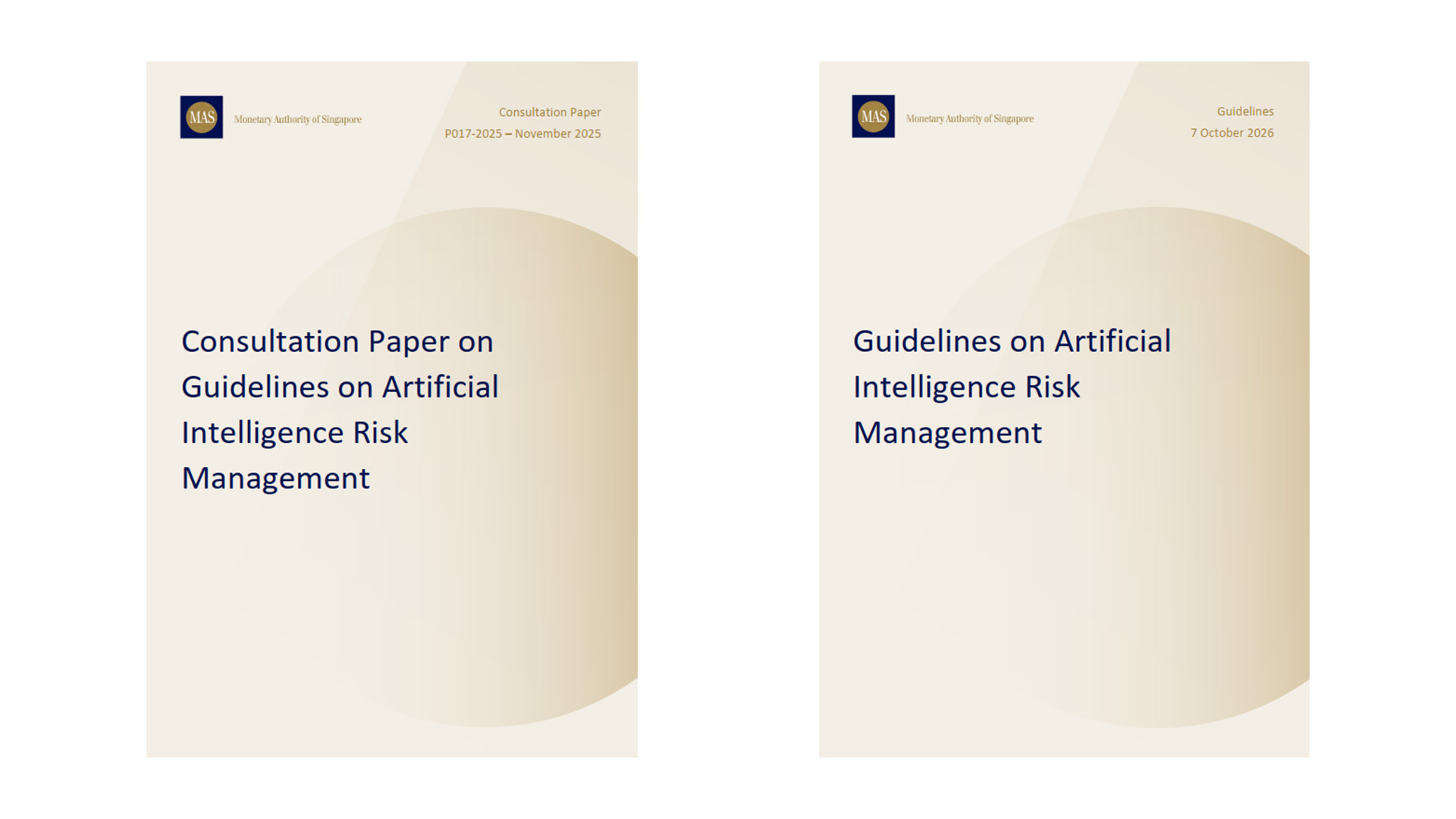
The final AI risk management guidelines (or AIRG) for Singapore’s financial sector were issued last week. I developed them while leading AI risk supervision at MAS. And its release brought back some memories.
Aside from this, a fairly packed week. A class for a visiting university programme of commodity leaders that I enjoyed. The AIRG came out midweek, so a scramble to update slides for a class next week, and share my own writings on it. A couple of ebooks that have been sitting there finally completed, one for the second and third line, one for regulators and supervisors. A few new projects and panels I said yes to, trademarks filed for the startup.
I started working on the AIRG in March 2025. I had just come back from three months of leave. My daughter had a transplant, and for a while nothing else was in my head. When I returned, it was to a blank page and a hard brief. Write something that did not really exist in this form anywhere yet and release then by the end of the year. And make it work for more than thousands of financial institutions, from the largest banks to the smallest fintech shops.
That gap, between a blank page and thousands of financial institutions is most of what I remember.
A short reflection on that journey.
Getting from nothing to something
The page was blank but it did not start from nothing.
I had been a model risk guy in MAS for many years before doing AI supervision. And I had used the distinction between model and tech risk to frame the 2024 thematic review on AI model risk management, which led to a MAS information paper. So model risk was where I started.
But my thinking had evolved. With Gen AI being used in more and more systems, and agentic AI starting to be the new catchphrase, it was not tenable to rely on that line between model and tech risk anymore. In a way, I probably had the same view as the authors of the US’ SR 26-2, the model risk guidance that replaced the original SR11-7. But our approaches diverged. Instead of restricting the AIRG to just models or not covering specific technologies, I expanded it. To cover use cases, systems and models. And to cover all AI, from machine learning to agentic AI. And hopefully beyond that. I’d always insisted on such an approach. In 2024, when asked to look at Gen AI specifically for the review, I said that made no sense.
As for writing the AIRG itself. There’s no template for a thing that has not been written before in this form. So it was outline after outline. Mapping after mapping to global AI governance literature. Nights spent reading other frameworks. Working with the industry folks in the Project MindForge consortium, who were concurrently writing the industry’s analogue to the AIRG. Arguing about what was fair to ask of a firm and what was not. On which sections in AIRG matched Project Mindforge’s. Even the naming. The Project Mindforge’s effort started as an AI governance handbook. That was then renamed to AI risk management handbook. I usually joke that if not for the need to ensure alignment, I could have finished the AIRG in half the time. But along the way, many of the folks in Project Mindforge became friends. That part was worth the additional time.
Somewhere in June 2025, I decided to leave MAS. But I also decided to finish what I had started. It would have felt wrong to walk away from something half-built that I cared about. So I saw my part through to the consultation, and then watched from the outside as the new team took it to the final version (I was pleased to see that perhaps almost 90% of the consultation version made it to the final version).
Then once the structure and expectations was done, came the slow work of adjusting the language. Even choosing which lines to bold. Then clearing the management committees in MAS. I remember going twice before we got their blessings. And I was quite happy to release it on 13 Nov 2025, before even the Singapore Fintech Festival came to town. Because it left me more time to pack up before my last day on 1 Jan 2026. I even had time to do a manual on what to look out for before I left.
What changed in a year
A year on, the world the guidelines were written for looks quite different, and in some ways worse.
We no longer talk about prompt engineering. The narrative has moved from prompt engineering to context engineering to harness and loop engineering, and also to decision models like Typesafe’s Jev.
And most recently, to the security risks of AI agents. In recent months, AI agents hacked into real systems during safety tests. Even into the Australian healthcare system. OpenAI is grumbling about the $500k a day they are spending analyzing the incident when they should have been hiring lawyers to defend themselves in a normal world. Frontier companies signed a voluntary accord to police themselves. The pace has not slowed. Self regulation won’t work.
The questions the AIRG keeps asking, who is accountable when AI fails, what the impact is, who owns the risk across its life, have only become more concrete. When I was writing them, some of it felt precautionary. Less so now. Some even asked me back then if there were really any real things to be concerned about.
My own life changed too. I went out on my own. I built a practice, and then a second startup. I now teach and advise on AI as well as AI risk management from the other side of the table, as the outsider brought in. I no longer work for one organisation, but at last count, work with more than 10 different organisations. But I don’t really have to answer to any of them if I choose not to. My income is no longer stable, but as volatile as can be. But I say what I want, write what I think makes sense, and do watercolors whenever I please. And my daughter is doing well, which matters to me more than any of the rest of it.
Some housekeeping
And since I am on this, some points on what AIRG is, and how it relates to some other things around it.
First, a quick word on what the AIRG actually is, because people mix this up. MAS has a ladder of instruments. At the top sit Acts, passed by Parliament. Below them, regulations and notices. All of those have the force of law, and breaching them can carry penalties. Then come guidelines, which is what the AIRG is. Guidelines are not law. Breaking one is not a criminal offence. But they are supervisory expectations, and how well you observe them feeds directly into how MAS assesses your firm. And there are consequences. So not law does not mean optional.
Separately from the instruments, MAS also puts out information papers and monographs. These share supervisory observations, thematic findings and research. The 2024 review I mentioned was one of those. Worth reading, but they are even less binding than guidelines.
It also helps to remember that MAS wears two hats. It regulates the financial sector, and it also develops it. The guidelines, the notices, the supervision, that is the regulator at work. Convening the industry, funding innovation, helping the sector build capability, that is the developer. The two are easy to mix up. And that is exactly where the next point comes in.
Project MindForge is not regulation or even supervisory expectations. It is the industry’s own set of practices, genuinely useful and worth reading, but it is not the AIRG that you will be judged against. And it helps to remember when it was built. Most of what MindForge did spanned 2024 and 2025. It captures where industry practice and consensus stood at that point, in a field that was moving fast and still is. A handbook like that is a snapshot of a moment, not a permanent standard. So treating it as a fixed checklist that regulators and supervisors will just blindly mark against is two mistakes stacked together. An industry practice treated as a rule, and a snapshot in time treated as settled for good. Treat it as a great and extremely useful reference, not as a checklist to apply blindly. Taking an industry practice and applying it as if it were a rule is its own kind of risk. So do not believe anyone telling you otherwise.
And on a related note, MAS’ SAFR, the runtime governance work I help just a little with, is the same. It is a white paper, a basis for collaboration and for thinking about hard problems, not a supervisory expectation. Do not confuse either of them with the guidelines themselves, and do not let anyone sell them to you that way.
By saying this, I may paradoxically have less business. But so be it.
What I would do again
If there is something to take from this for anyone building a thing that does not yet exist, it is this.
You will not get it right on the first outline, or the tenth. The clarity comes from arguing it out with the people who will actually have to live with it, not from writing it alone at your desk.
I believed in this one. I still do. It is a strange thing to write a thing and then walk out the door almost immediately.
But I would do it again. Both the writing and the leaving.
#AIGovernance #AIRiskManagement #AIRG #Reflections #Transitions
I’ve collated a fair bit of my notes and thinking in my second brain (with help of AI of course) into a simple hub with quite a fair bit of information on AI risk management (not just AIRG). See link below.
https://quaintitative.com/complete-guide-ai-risk-management-finance-singapore/
Thanks . Gary. This is helpful
Thanks Gary. So if one has to apply SAFR or AIRG, they can use or factor them into their design.