

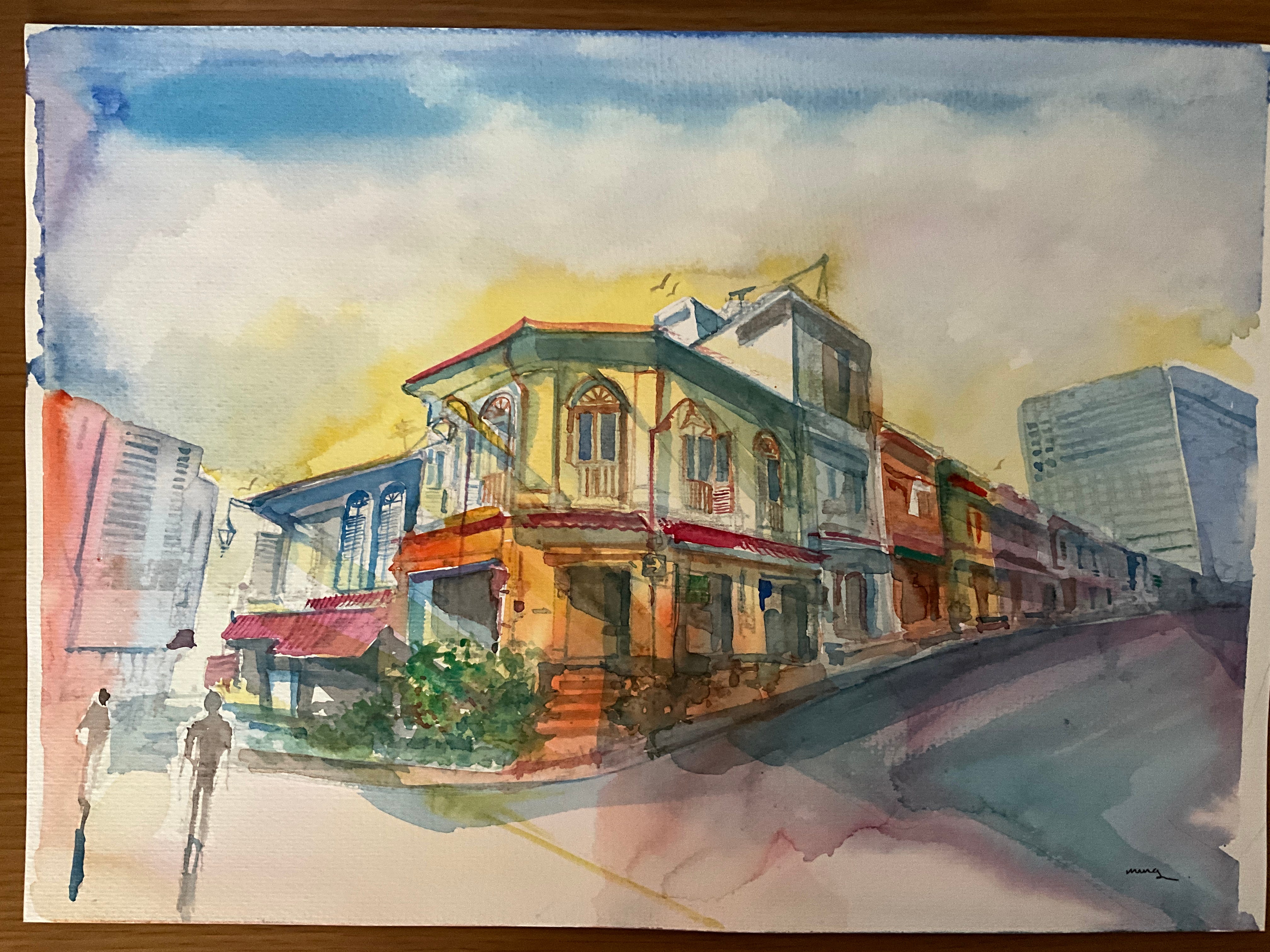
~300 watercolors in one video. And a question on authenticity.
The past week I laid out every watercolor I have painted in the last two years. Just over three hundred of them. I did it to make a short video to see how my style has changed and try to get better. But somewhere in the middle of compiling it, I started thinking about authenticity and AI.
It was a full week otherwise. I finished my July series of AI risk management courses for the Association of Banks in Singapore - three runs, and by the end the feedback had flipped from “too technical” to “we want more”. I enjoyed an evening talk on time series forecasting at SMU for a mix of Singaporean and Korean masters students. A paper on AI and the workforce co-authored with ATA that went out, that I also enjoyed writing. A pile of slides for the weeks ahead. A number of training proposals - requests that interestingly came through my website. And, as always, a watercolor most nights before bed.
But it was the menial process of scanning three hundred paintings (which I did not enjoy at all) that sparked some thoughts.
Proving authenticity with AI is kind of stupid
You cannot fake a real physical watercolor piece. The water goes where it wants. The paint shifts in a way no one fully controls. It is impossible to do the same exact piece of the same scene with watercolors, even if you used a robot. In a world where almost nothing is provably human anymore, that turns out to be fairly uncommon.
And it made me think about writing, because judging authenticity in writing is hard. And somehow or other, it has become a lightning rod.
You cannot prove you wrote something by hand. Writing that we consume these days is rarely physical. Even if you sat down with pen and paper - you would still type it in to post it. Nobody handwrites a page, photographs it, and uploads the photo. (For now at least. Maybe someone will have some ideas after this.)
Whatever physical act happened, if it happened at all, becomes irrelevant the moment it goes online. No one can tell you who or what put the words there.
Substack recently started scanning posts with an AI detector called Pangram, and it did not go down well. The idea is to hand back some of that lost proof - to score how likely a piece was written by a machine. With a machine (!?).
I understand the instinct. But it is solving the wrong problem, doing it badly, and with a machine that could be generating slop itself.
Start with badly. Writers began getting flagged on their own work that’s theirs. Not AI.
I call this using AI slop to find AI slop.
We think we are solving the problem of AI slop. But Pangram itself may be slop. Biased slop that may fall hard on people who write in a certain way, such as non-native speakers of English.
And even a perfect detector would be solving the wrong problem. The process was never the point. If we grade writing by how little AI touched it, we are measuring the purity of the method, not the worth of the idea. It rewards effort and ignores whether there was any thought behind it.
What is left
If you cannot prove how something was made, the only thing left to judge is whether it is any good. Whether there is a real idea in it. Whether a real person, with a real stake in what he is writing about, stands behind it.
That is uncomfortable, because it is harder. It is much easier to check a box that says “100% human” than to ask whether someone actually has something to say.
The watercolor is safe from all of this, and that is probably why I hold on to it. It is the most uncorrelated thing I have - slow, on paper, no prompt, no model. And if you ask me for proof, I have it. Indisputable. No slop like Pangram getting into the mix.
I have no idea how to solve AI slop. But let me reframe it as three questions.
One, do we need another possibly biased AI black box to tell us something is slop?
Two, if we let go of proof - if we accept that we can no longer tell the human from the machine, and choose to judge only the idea - do we lose something real?
Three, do we really know what authenticity is? It has changed, numerous times, across the ages.