
Remember that joke about Bill Gates’ daughter? A memory from my younger days reminded me of it. If you don’t know it. Read on.
But first, let me take a step back to explain what I am doing.
I’m trying to start a series of articles about what happens when the people who make things meet a technology that also makes things.
AI and art. Illustrators, theatre directors, designers. Asking them what’s changed, what hasn’t, what they’re afraid of, what they’re not afraid of enough.
It matters to me.
Because I do both AI and art.
And I am getting kind of impatient with the folks who keep saying artists are doomed.
So to start it off, I went looking for something that I did when I was young. Not the memories. The evidence. I wanted documents. Proof that the thing we built actually existed.
Johnny Lau
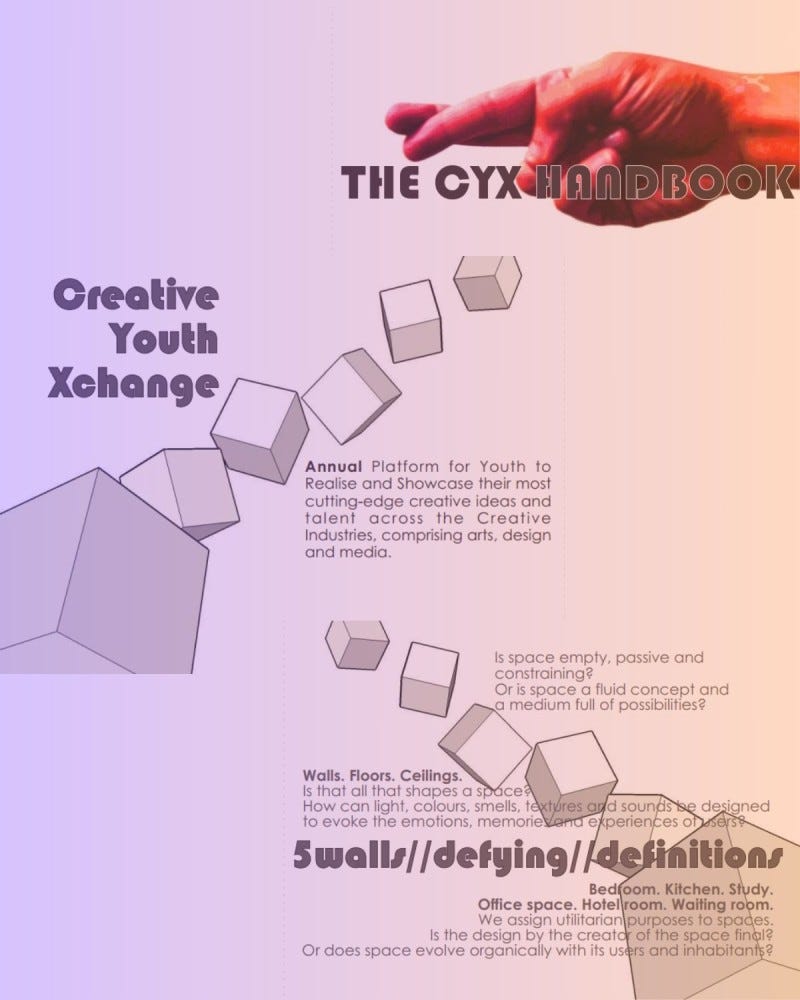
Because I wanted to interview the first mentor that taught me how to break the rules. And we had built that thing together. It was called Creative Youth Xchange (CYX).
That mentor’s Johnny Lau.
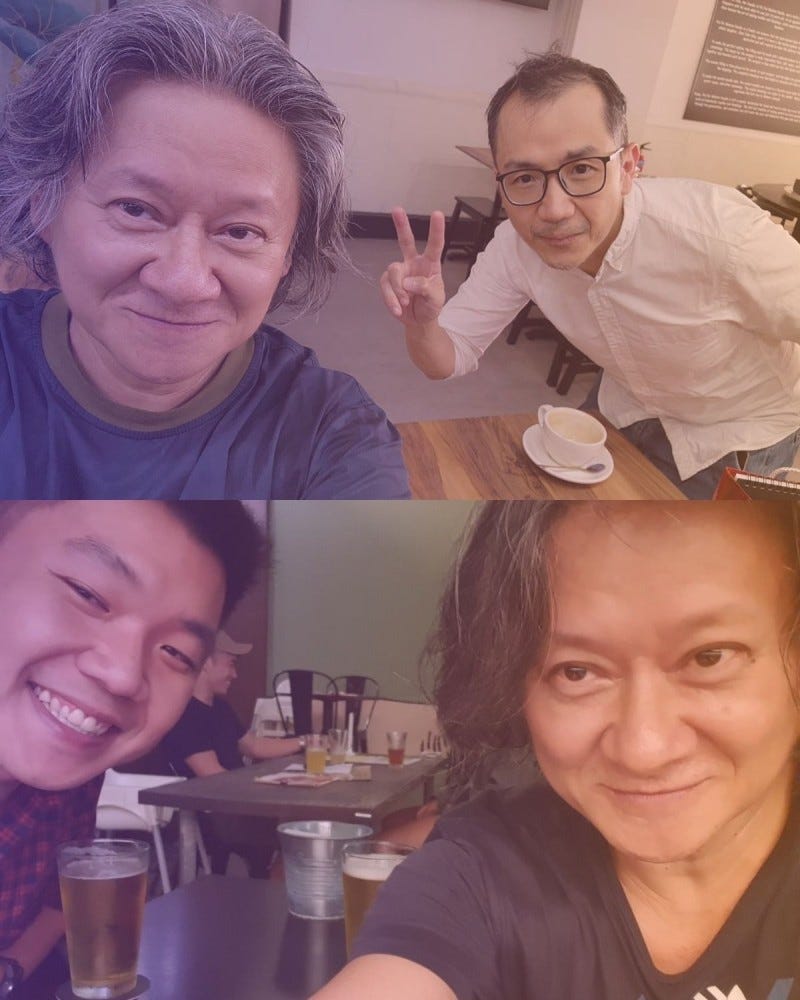
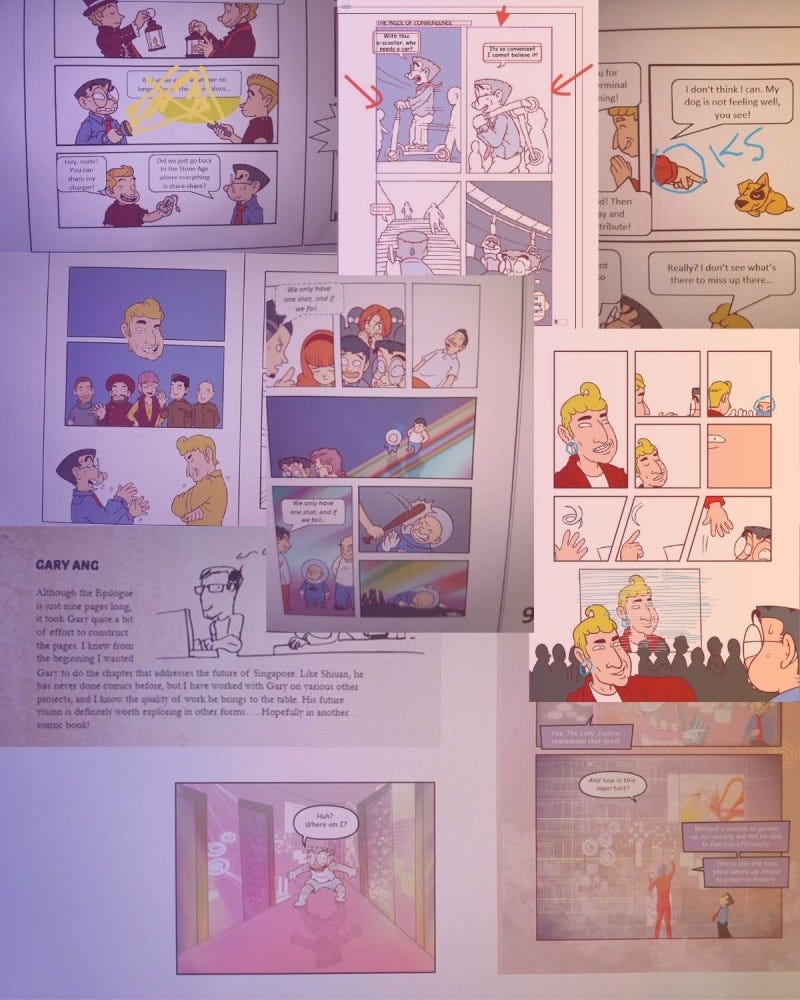
He’s not the obvious choice for a book about AI. He’s a comics creator who’s been drawing by hand for thirty-five years.
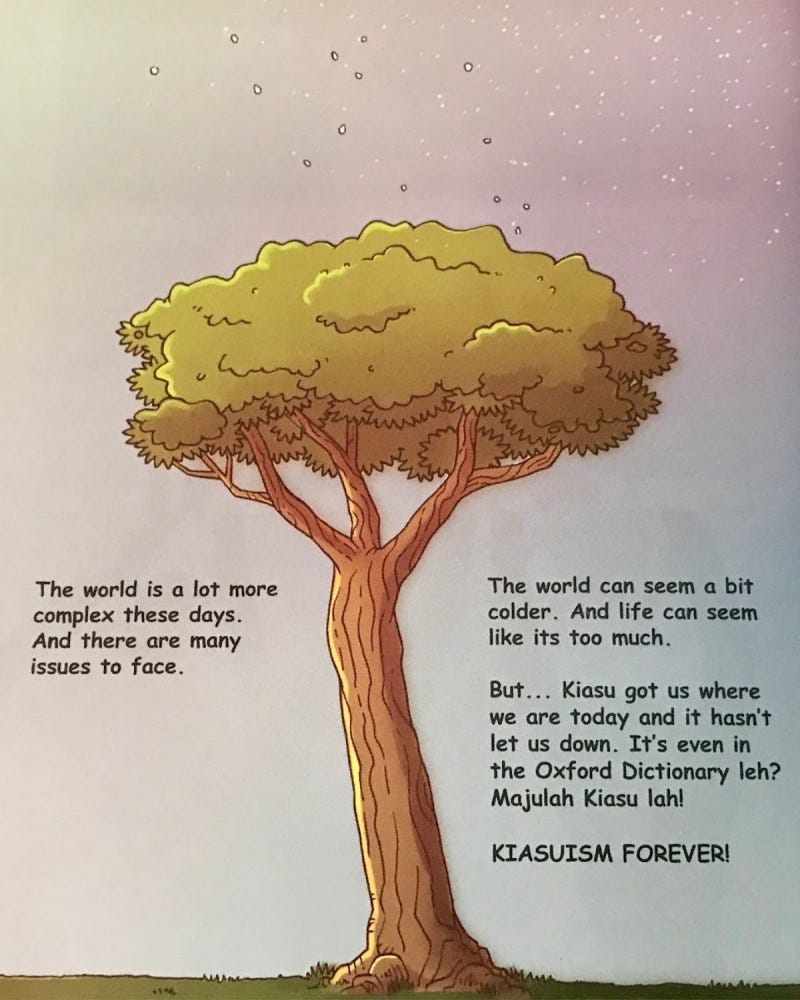
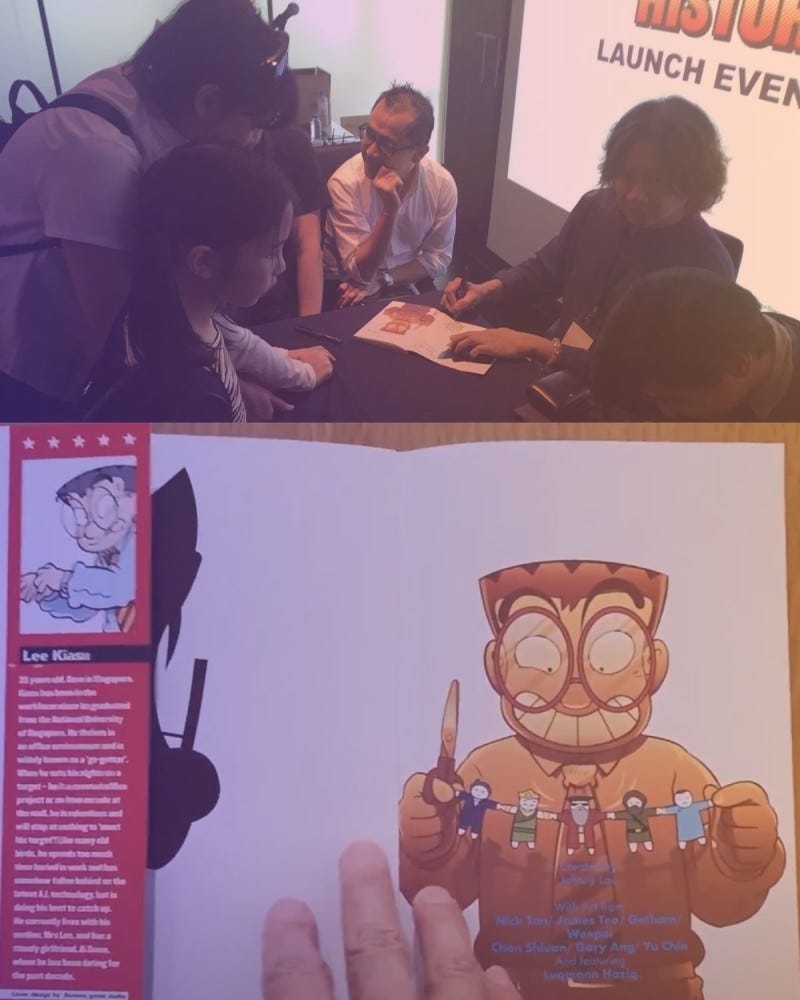
One of his creations is Mr Kiasu. For those that remember, Mr Kiasu was a cultural icon that everyone could relate to in the 90s.
The Experiment
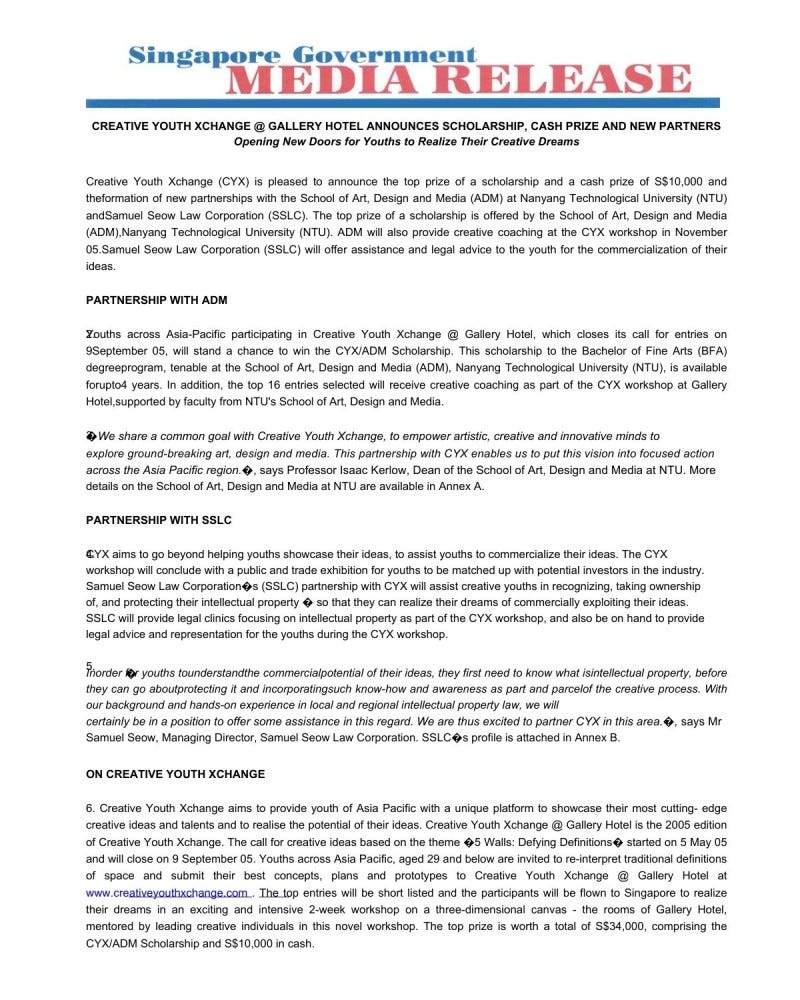
I found two press releases. The first, dated 10 August 2005: “Creative Youth Xchange @ Gallery Hotel ....” The second, 23 November 2006: “Creative Youth Xchange @ Hello Kitty ….” Both drafted in bureaucrat speak. Neither says much about us. And so boring.
My fault. I was the one who wrote them. In the press releases, CYX sounds fully supported and funded.
It wasn’t.
It was a crazy experiment. We had almost no funding. What we had was a boutique hotel on Robertson Quay - Gallery Hotel, that strange blue building with mismatched coloured window frames - and a programme we were making up as we went along.
We flew sixteen kids from seven countries to Singapore, gave them hotel rooms, and told them to turn those rooms into art.
What I learned from Johnny then. The trick to getting a programme funded when you have no budget is the same as that old joke. You tell your son he’s marrying the girl you choose. He says no. You tell him she’s Bill Gates’ daughter. He says OK. You call Bill Gates and say your daughter is marrying my son. He says no. You tell him your son is the CEO of the World Bank. He says OK. You call the World Bank president and ask him to make your son CEO. He says no. You tell him your son is Bill Gates’ son-in-law - he says OK.
That’s how CYX got built. Gallery Hotel gave us the rooms because we had NTU. NTU gave us the credibility because we had the hotel. Johnny convinced the creative network because we had government backing. Nobody had fully committed to anything, and somehow it happened.
The Gallery Hotel is an InterContinental now. The CYX website doesn’t exist anymore.
The press releases survived. But they don’t tell you what it felt like to be in those hotel rooms at midnight, watching a twenty-year-old from Indonesia build something you couldn’t have imagined in your brief.
Anyway, that’s how I met Johnny.
Twenty years later, I’m wanted to interview the man who taught me to break rules. About a technology that breaks everything.
AI as a Forcing Function
Johnny Lau created Mr. Kiasu. Hundreds of thousands of copies sold. A McDonald’s tie-in. A TV sitcom. A stage musical. A character so embedded in Singapore’s psyche that “kiasu” -a Hokkien word for the fear of losing out became an adjective everyone understood.
So I asked him the question I came for.
I asked him how technology has changed the way he approaches art.
Most artists I’ve spoken to say technology threatens artistic purity. Johnny said the opposite:
“Because technology complicates the process and our lives, art plays a more critical role in shaping our collective consciousness. Technology is thus pushing us, pushing me towards a purer form of communication and expression.”
In his view, AI, like all other technology, is not a threat. It’s a forcing function. Technology forces purity. It’s not destroying art. It’s burning away everything that isn’t essential, leaving behind the thing that only a human can do.
Feed an AI enough Mr. Kiasu images and it’ll learn: round glasses, anxious expression, exaggerated posture, Singlish syntax in speech bubbles. It’ll learn the look. What it won’t learn is why Singaporeans laugh.
“Kiasu” is a Hokkien word for something close to a national neurosis. The humour depends on self-recognition - readers seeing themselves in the caricature and cringing. You laugh because you’ve been that person in the hawker centre queue. You’ve cut that line. You’ve been cut. The joke only works if you’ve lived it.
Style is a pattern. Culture is a relationship.
The model can approximate the first. The second requires being from somewhere.
And this is not unique to comics. Think about any art form rooted in a specific place. Getai performances during Hungry Ghost Festival. Malay pantun where the meaning lives in what’s left unsaid. Tamil kolam patterns drawn fresh every morning, gone by noon. AI can reproduce the form. It cannot reproduce the why.
If AI can handle the patterns - the technical skill, the rendering, the surface - then what’s left is the part that was always the point.
In a world of AI slop, the authentic creation is even more valuable.
Living with AI
Back to the present. I asked Johnny what he’s working on now. He said:
“Very few things on this earth ever excites me anymore! My goal now is to create frameworks using the stuffs that I’ve created so that they can be utilized by people who comes after me.”
Frameworks.
I think in frameworks. It’s almost a compulsion. That’s how I survived in complex domains. By using frameworks to make the overwhelming manageable.
And it makes sense for Johnny Lau. He’s an architect. A building is a framework.
And now he wants to make frameworks for making a creative life transmissible. Different domain. Same impulse. Making complexity portable so someone who comes after you can pick it up and use it.
He calls it a “Life-Framework.” A structure for co-existing with AI. Built not from theory, but from thirty-five years of making things.
I find that striking. We talk about AI replacing creative work. Johnny isn’t arguing about replacement.
He’s asking a different question entirely - what do I leave behind that AI cannot generate? Not the drawings. The way of drawing. Not the stories. The reason for telling them. The method, the instinct, the accumulated judgment of a life spent making things. Can that be made portable?
We are both compiling in 2026. I’m writing every week to make sense of things. He’s archiving a life’s work to make it transferable. One with words, one with drawings.
The question underneath is one I think about every day: How do you build a structure for living alongside something you don’t fully understand?
I’ve lived as close as one can with AI for the past few years, but I cannot truly say I understand AI. I can’t imagine how it must be for someone who has never actually touched the underlying nature of AI - the model.
The Questions
I’m writing a series on what happens when the people who make things meet a technology that also makes things. Not the hot takes. The actual conversations. Johnny is the first. And these are not the only questions I asked Johnny. I am still processing the rest.
Perhaps another article. Or a book chapter.
There’s an assumption buried in most AI conversations: that what matters about creative work is the output. The drawing. The strip. The punchline. Johnny’s perspective is different.
What matters is the judgment behind the output - the thirty-five years of decisions about what to draw, what to leave out, when a joke is punching down instead of punching up. AI can learn his line weight. It can’t learn his artist’s instinct.
I agree.
That’s the thing worth transmitting. Not the art. The artist’s operating system.
And here’s the question I’m leaving with him, and with you.
If AI generated a Mr. Kiasu strip - culturally accurate, funny, visually in his style - would it be a Mr. Kiasu strip? Not whether it looks right. Whether it is right. What would be missing?
More soon.
#AI #Art #MrKiasu #Singapore #CreativeIndustries #AIandArt