

This is the second in my series on what happens when the people who make things meet a technology that also makes things.
The first part, “My Shifu“, covered how I met Johnny Lau through a crazy experiment called Creative Youth Xchange, and his view that technology forces artistic purity rather than threatening it.
I’ve been sitting on this, but this post by Arvind Narayanan on how creativity in art and creativity in science are different made me get back to this second part.
This article goes deeper into the creative process. About creative production, and why AI may not be that great a leap.
Is AI Really A Leap?
One of the key fears of creatives is that this leap into AI may be one too far. Further than the camera. Further than digital tools.
Something that creativity cannot keep up with. But is it realistic to think that all art in the future will be purely from AI?
So I asked Johnny about his jumps from pen-and-paper comics to different technologies, the most recent being a Singlish speaking robot. Most people would call that a transformation. He didn’t:
“It was never a leap for me. Right from the beginning when I launched the first book in 1990, I engineered a range of products such as t-shirts & mugs, a 13-inch ruler and bumper sticker with a tagline: Beware of Kiasu Driver. The latter became a bestseller instantly.”
My read. This leap is perhaps not that different from the ones in the past for creatives. And AI is perhaps more of an opportunity than a threat.
“For me it has always been a concept, not a book nor a sticker ... My brain doesn’t function the way where sectors and industries are differentiated. I had to develop a language to align myself with how the world functions.”
A concept. Not a product. Not a comic.
Here’s what I think is going on. Narayanan’s distinction is useful, creativity in art is emotional, social, driven by taste. Creativity in science is instrumental, evaluable, a systematic search through possibilities. AI is getting better at the second kind. The first is harder to touch.
Johnny’s concept is the first kind. Not the drawing - the reason for the drawing. The cultural nerve. The recognition that makes a Singaporean laugh at their own kiasu-ness. That doesn’t live in a dataset. It comes from being someone, from somewhere.
The production - t-shirts, mugs, strips - is the second kind. Patterns. Systems. Things that can be decomposed and delegated.
Johnny worked this out decades ago. He kept the concept. He systematized the production. And the person who showed him how wasn’t an AI researcher. It was Jim Davis.
The Garfield Revelation
I asked about architecture at USC. He said something I didn’t expect - that USC was never about architecture for him:
“The years at USC were never about the study of building design. I took full liberty to immerse myself in the world of media and entertainment when I landed in Los Angeles.”
That’s where he met Garfield. Not the cat. The operation.
“I was stunned by Davis and how he had built a team of artists and writers to produce daily comics strips for the lasagna loving cat for its national syndicate. He had deployed an animation studio system to run his comics studio.”
Here’s what he described. Davis ran his comics like a factory. Team meeting on Monday. Different themes tossed around for the week’s seven strips. Once decided, a lead artist carried out the drafts. The process cascaded through the team. And at the end:
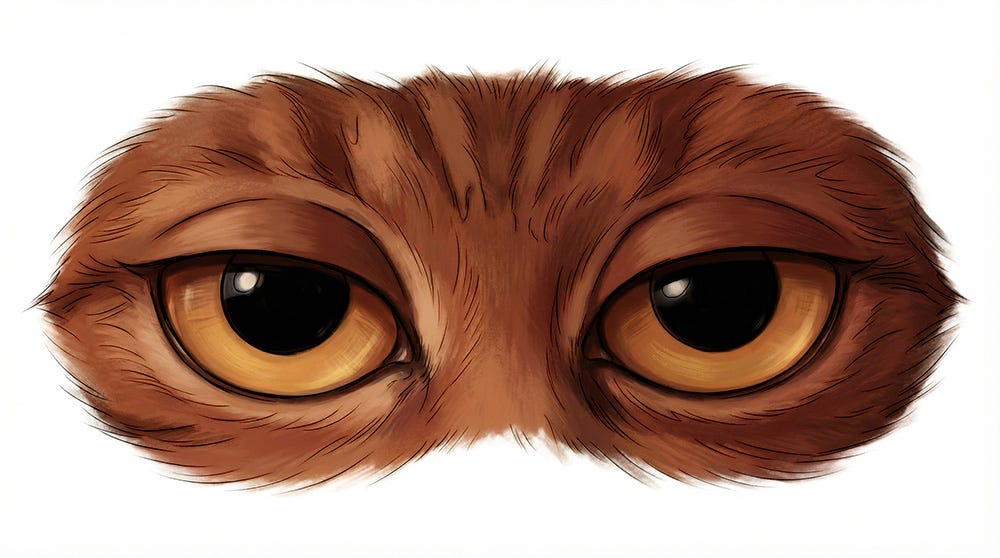
“Davis merely just drew Garfield’s eyes as a gesture of completion.”
Garfield’s eyes. The signature. Everything else was system. That one stroke was authorship.
I sat with that image for a while.
Johnny brought this model back to Asia. Most Asian comics were produced by a single artist - one person doing everything. The Garfield team showed him a different path. It became Comix Factory, the studio that produced Mr Kiasu.
Agents and Art
Here’s the connection I keep thinking about.
Davis’s studio system was, in effect, an early version of what AI promises every creator today. Break the work into steps. Specialize each step. Let the system handle volume while the creator handles vision.
I’ve written about agentic AI before - systems where multiple AI agents each handle a different part of a task. One agent plans, another retrieves information, another reasons, another generates output. The whole thing works because each part has a defined role and you can observe what each part does.
Davis was essentially running an agentic system in the 1980s. Just with humans instead of models. One person for drafts, another for inking, the process cascading through the team. And the orchestrator - Davis - only needed to draw the eyes.
Davis understood in the 1980s what the AI industry is selling in the 2020s: you don’t need to do everything yourself. You need to know what only you can do.
For Davis, it was the eyes. For Johnny, it’s the concept.
And Johnny made the connection himself:
“Similarly with AI, we just have to change our mindset on the method of production. The creation portion doesn’t change as it will always come from the depth of our minds.”
Change the method of production. Keep the creation. That’s not a theory from someone who’s read a few articles about AI. That’s a principle from someone who’s been decomposing creative labor since 1990.
A nice footnote: in 2023, Mr Kiasu and Garfield collaborated on a joint library programme with Singapore’s National Library. A one-of-a-kind global collaboration between two comics characters - the Singaporean one modeled on the American one’s production system - sharing a stage forty years later.
AI As Just Another Method
There’s a broader pattern here that I think matters for anyone thinking about AI and creative work.
We tend to frame the AI question as: will machines replace artists? That’s the wrong question. The better question is: what part of your creative work is system, and what part is signature?
If you’re a writer, maybe the system is research, outlining, drafting. The signature is voice, judgment, the instinct for when a sentence lands. If you’re a designer, maybe the system is rendering, iteration, production. The signature is the concept that no brief could have specified.
Davis knew. He drew the eyes and let the system do the rest. Not because he was lazy. Because he understood what only he could do.
AI doesn’t change this question. It just makes it unavoidable.
Johnny figured this out before AI existed. He’s been running this model for thirty-five years - concept first, production second, and the concept crosses every medium, every platform, every technology that comes along.
The question I’m leaving with you: what’s the part that only you draw?
More soon.
Wow, this is such a lovely, insightful piece! Now it has gotten me thinking, “what’s the part I’ll draw?”