

When I shared an early draft with a friend, his first question was:
“How much of this was AI?”
For a while, it made me a little sensitive. Even made me question if I should share this book.
Not because the question was unfair. It’s a reasonable thing to ask. It’s almost automatic to question the origins of any work these days.
But because it implied something I wasn’t sure how to answer cleanly.
If I said “a lot,” it sounds like the book isn’t mine. And perhaps just slop.
If I said “not much,” that’s really not honest either.
So let me just show you. Full transparency.
(Just scroll to end if you want to skip all this)
AI or me?
This book is part me, part AI. And I want to show you exactly where the line is.
What’s mine
The architecture. The four-pattern framework. The decision to organize the book around Tool Calling, ReAct, CodeAct, and Orchestration - that came from reading papers, building prototypes. No model suggested that structure.
The frameworks. The Hamburger Principle mental model came from a LinkedIn post I did to explain how I use LLMs. The Complexity Ladder came from watching people skip straight to agents when a simple API call would suffice. These are my patterns that I got from observation and learning, not generation from a prompt.
The judgment calls. What to include. What to leave out. When to go deep on code and when to step back and explain why it matters. The decision to start with the trust problem - not with “what is an LLM?” The decision to end with an assessment of what the reader can and can’t build.
The weird voice. The tone. The “I like simple and boring.” That’s not a style a model learned. That’s the thing I have to tussle with every generation of LLMs. LLMs think they know too much.
What’s AI
Drafting speed. First drafts of chapters, generated from detailed outlines I wrote. I’d specify the concept, the framework, the examples, the level - and Claude would produce a draft I could shape.
Code scaffolding. The notebook code, the tool definitions, the API integrations. I described what each tool should do. AI wrote the implementation. I tested it, caught the errors, fixed the edge cases.
Production work. Converting eleven chapters from Markdown to LaTeX is no joke. The grunt work that would have made me give up. AI also did the documentation of the n8n workflows I strung together, and of the financial concepts from my notebooks.
Research synthesis. Pulling together documentation, API references, library specifications. Summarizing what I needed so I could decide what mattered.
When you read the book, you will recognize the pattern. It’s the one I talk about, incessantly, in most of the book.
The Hamburger Principle - applied to writing the book itself
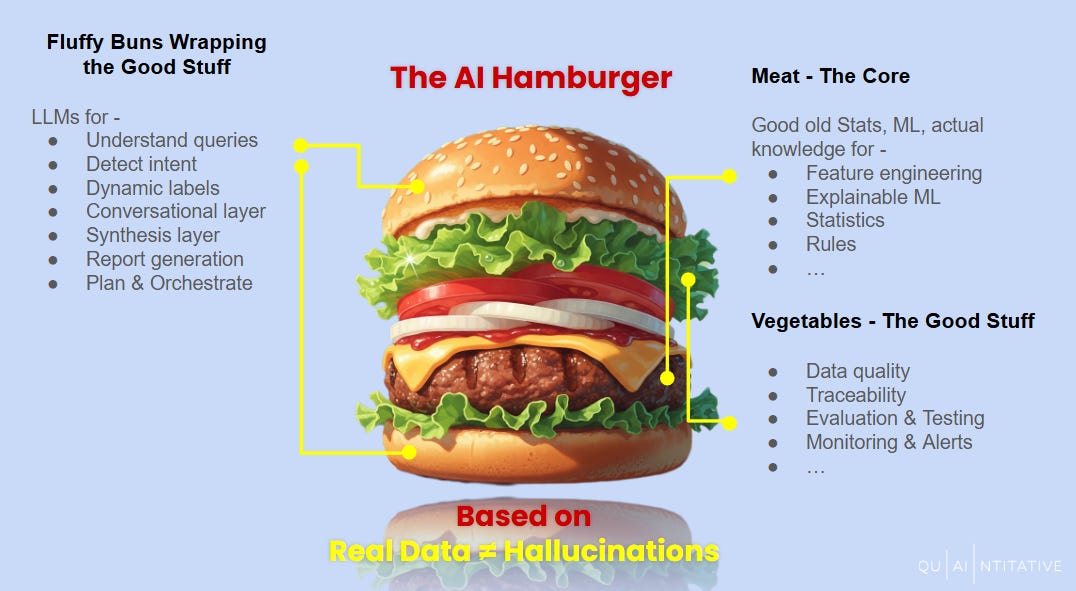
Claude was still the bun. It parsed my instructions, understood what I wanted, generated prose, and communicated ideas in readable English. That’s what LLMs do - the language layer. Same role as in every agent pattern in this book.
The meat was my domain knowledge and the tools - LaTeX compilation, yfinance APIs, MCP servers. The real things that the language wrapped around.
And the vegetables? The infrastructure in between. The project files that kept everything organized. The version tracking. The convention lists. The consistency checks.
I was the chef. Not a layer of the hamburger - the one directing the whole thing. Choosing the ingredients, deciding what goes in, what comes out, and whether the result is any good. And the one getting frustrated at the bun.
The same approach covered in the book. Applied to its own creation.
Quite meta right? I am quite pleased about this weird recursion.
The rest of Chapter 14 in the ebook goes deeper.
The actual setup - two tools, three files - and why those three files are the difference between productive AI sessions and wasted ones. The writing workflow. What “directing AI” actually looks like step by step. What AI genuinely could not do. That part is still entirely human. Where AI actually saves time. It’s all in the book, free to download.